Why Template Benefits Don't Work (And What to Do Instead)
Your company isn't average. So why is your benefits plan?


Your company isn't average. So why is your benefits plan?
Canadians already know "all-season" is a compromise
Every fall, Canadian drivers have the same debate: are all-season tires good enough? The name promises everything, and that's the catch. Transport Canada says that below 7°C, all-seasons fail, while winter tires hold up. It's why plenty of Canadians call them three-season tires.
An all-season tire isn't a bad product. It's built to do a bit of everything. The problem is that nobody drives on "everything." You drive on your roads, through your winters.
Most group benefits plans are all-season tires.
What is a one-size-fits-all benefits plan?
A one-size-fits-all (or template) benefits plan is a pre-built package of coverage categories, like prescription drugs, dental, vision and paramedical services. Each category has a fixed limit, and every employee gets the same package. The categories and caps are set before anyone knows what your team will need, and they're locked in until renewal.
Templates became the default because they scale. A standard package is easy for insurers to price and sell, and easy for employers to buy. But it forces your employees into fixed buckets in advance, based on how an "average" employee is expected to use them, while the Sponsor pays for the whole lot.
And the split doesn't change when your people do.
Meet Northbridge Supply Co.
Northbridge is a 40-person distribution company with warehouse, dispatch and office staff. In other words, a completely normal Canadian small business. Here are three people on its plan.
Jordan, 24, warehouse associate. Single, active, and on his feet all day. He uses physio or massage for the wear and tear of warehouse work, plus routine dental. His plan also provides drug coverage, vision care, and a long list of categories he won't touch for years. On paper, it's generous. For Jordan, most of it is dead weight.
Sam, 35, dispatcher. Married with two kids under eight. Her plan technically covers what her family needs. It just doesn't cover enough. Her son needed new glasses twice this year, and the $200 vision maximum only resets every 24 months. Her youngest started speech therapy, and a handful of sessions used up the $500 annual cap. By spring, Sam is paying out of pocket for care her plan "covers."
Elena, 52, office manager. Fourteen years at Northbridge, with ongoing prescriptions and regular physio. Her prescriptions are well covered. Her physio isn't. She gets the same $500 maximum as Jordan despite using her benefits about four times as much, so by summer she's paying for her own appointments.
Did you know at the 2025 Benefits Canada Healthcare Survey launch, the CEO of the Canadian Chiropractic Association said paramedical maximums haven't meaningfully risen in the three decades she's worked in the field.
The plan looks great. Then you score it.
Here's Northbridge's plan the way it was sold: every major category included, reasonable-sounding limits, a checkmark in every box.
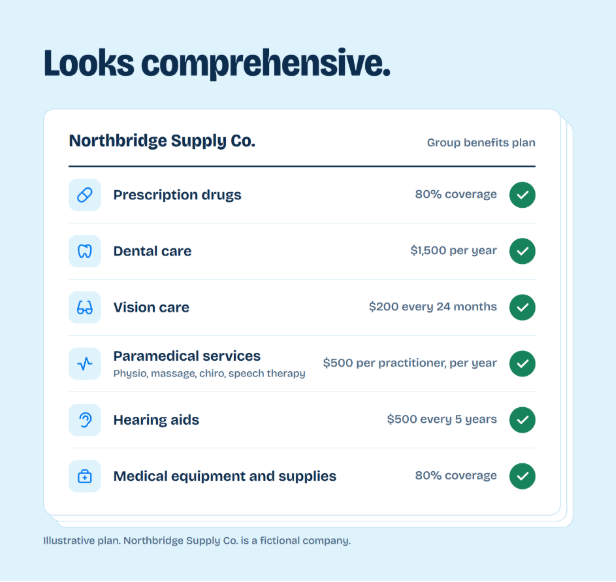
Now score the same checklist against the three people who actually use it.
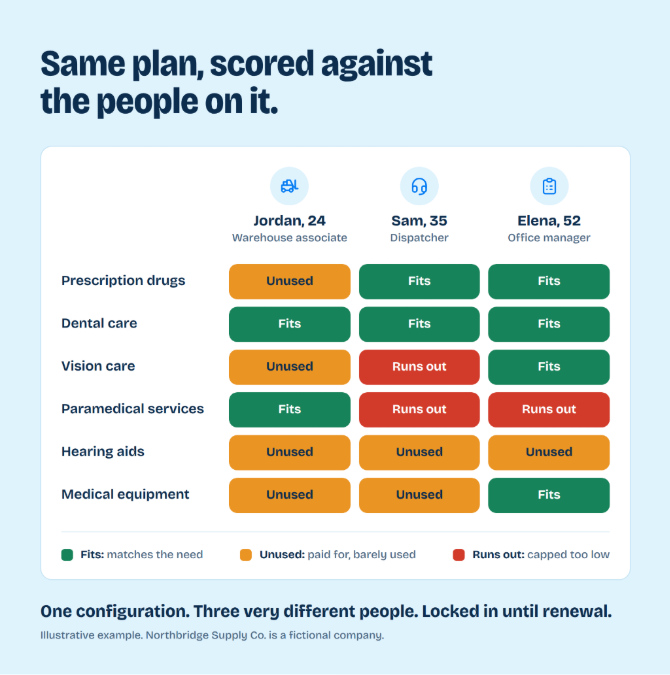
Jordan's column is mostly amber: coverage paid for, year after year, that he'll rarely use. Sam's goes red exactly where a young family leans on the plan. Elena's is green on prescriptions and red on the care she needs most. One configuration, three very different people, locked in until renewal.
Northbridge is made up. The pattern isn't. In the 2025 Benefits Canada Healthcare Survey, more than half of plan members had maxed out at least one benefit, most often dental, vision or massage therapy. The people most likely to hit a cap were women, caregivers and members aged 35 to 54. That's Sam and Elena, almost to the letter. And when coverage ran out, 34% said they'd pause treatment until their plan year reset, while another 16% would stop altogether.
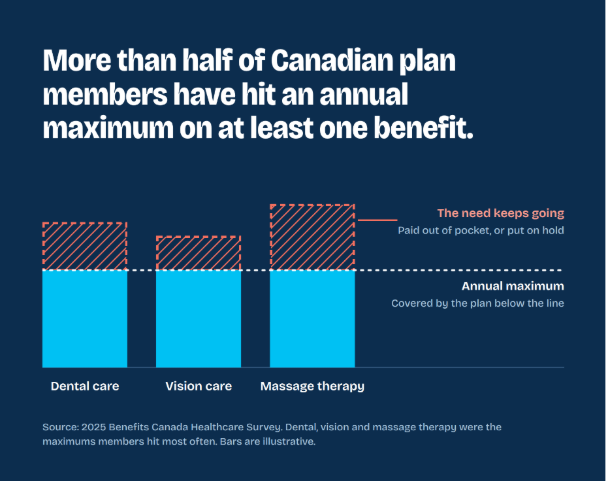
It shows up in how people feel about their plans, too. In the same survey, 84% of plan sponsors rated their plan excellent or good, versus 71% of members. When members were offered an extra $10,000 a year instead of their benefits, 60% said they'd take the cash. That's the highest share since the survey started asking. Members who'd maxed out their physio, chiropractic or dental coverage were more likely to take it. Better communication helps. But a plan built around average usage will always shortchange the people who aren't average.
Aren't flex plans the fix?
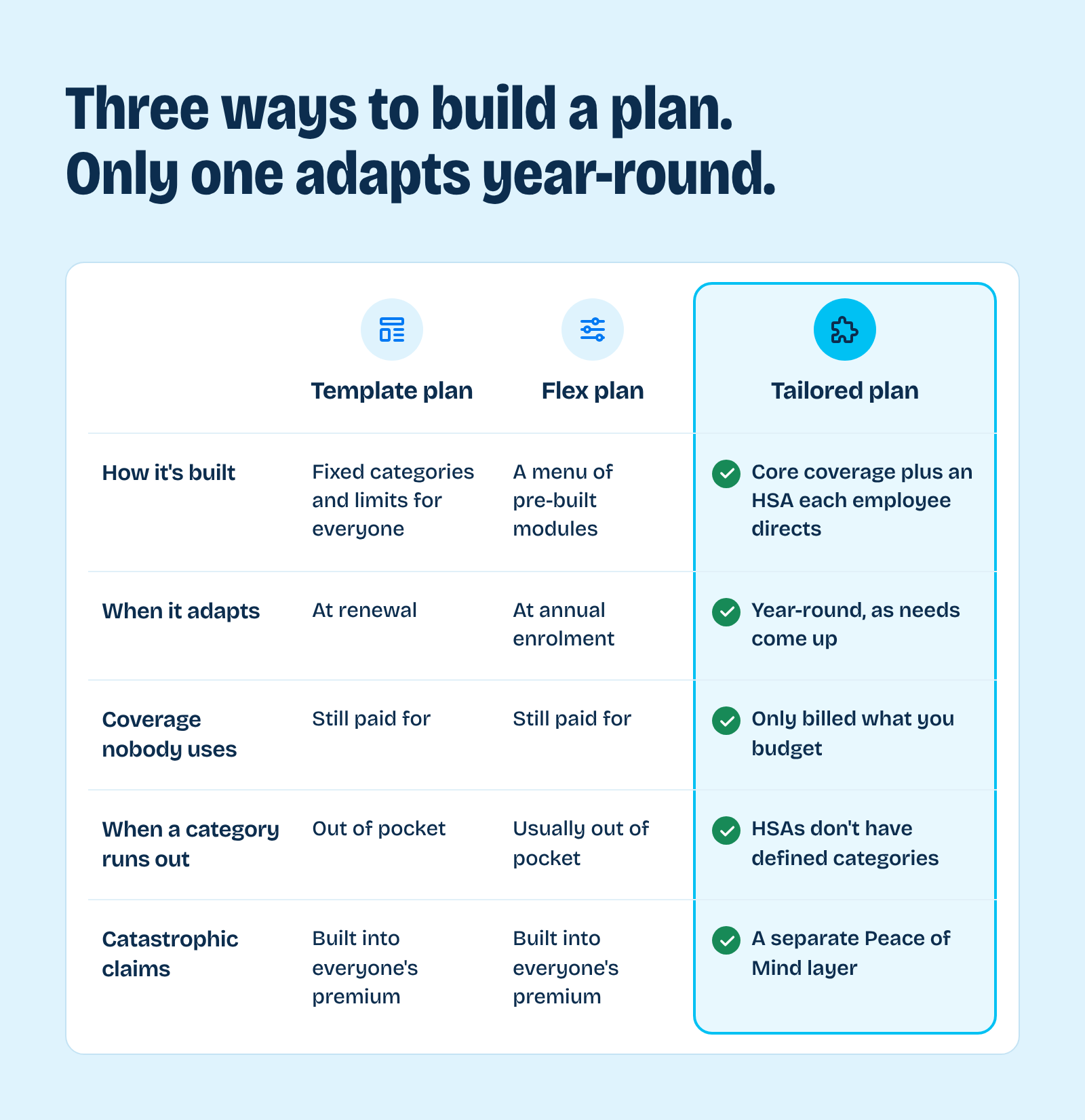
Flex plans are a genuine step up in choice, but they're still templates with a longer menu. Employees pick from pre-built modules once a year based on their best guess, and each option is priced on the same expected-usage logic. Jordan can choose a leaner module. Sam can buy a richer one, but it still has fixed caps, and she has to predict at enrolment what her kids will need next spring.
You're paying for the average, too
With an insured template plan, you're not paying for what your team uses this year. You're paying for what the insurer expects a team like yours to use. Premiums are set to cover expected claims plus the insurer's expenses, reserves and an allowance for inflation. So, every "just in case" category is priced in whether anyone claims it or not. Jordan's amber boxes are on the invoice every month.
And the invoice keeps growing. ZLC Employee Benefits Solutions puts group benefits inflation at about 6% a year on average over the past 25 years. It forecasts extended health costs climbing another 6% to 10% in 2026. Inflation doesn't fix a mismatch. It compounds it.
What tailored employee benefits look like
The fix isn't a better average. It's the right tires for the roads you actually drive. A tailored plan is built in three layers, each doing one job well.
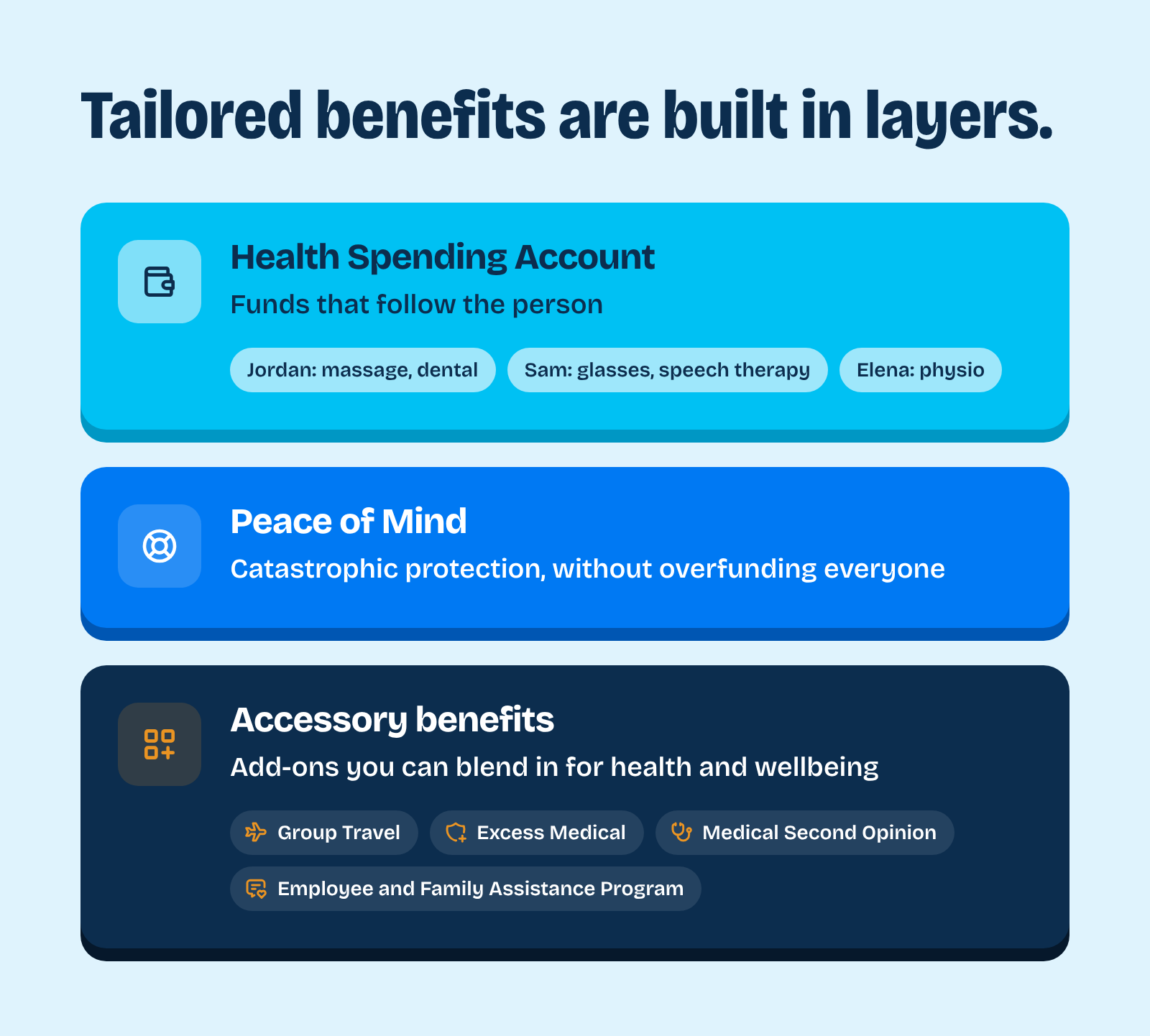
Health Spending Account (HSA): funds that follow the person.
The employer sets an annual amount for each employee to spend on the wide range of health and dental expenses the CRA considers eligible. Reimbursements are tax-free for employees and tax deductible for employers.
Peace of Mind: catastrophic protection, without overfunding everyone. Large, rare claims get their own layer instead of inflating everyone's routine coverage. That's the answer to "what if someone gets seriously sick?" Your team stays protected, and nobody overpays for day-to-day care to fund it.
Accessory Benefits: Coverage for those extra “nice-to-haves”. Employees get additional coverage like travel that supplements their current coverage. These are what we call your “braggable benefits”
Rebuild Northbridge this way and the scorecard turns mostly green. Jordan's HSA goes to massage and dental. Sam covers the second pair of glasses and the speech therapy. Elena keeps seeing her physio all year. You don't have to re-engineer the whole plan. You just stop pre-deciding where every dollar goes.
Template vs. flex vs. tailored benefits
Your company isn't average. Your plan shouldn't be either.
Canadians figured out a long time ago that "all-season" doesn't mean every season. It's time benefits caught up. Jordan, Sam and Elena don't need a thicker booklet. They need a plan built for the people they actually are.
Remember to check us out on Facebook, Instagram and LinkedIn for more benefits bite-sized content!